
3D Printing
Additive Manufacturing
3D printing works by breaking a digital 3D model into thin horizontal layers, then physically building the object one layer at a time until the full part is formed. The most common method, FDM (Fused Deposition Modeling), works by feeding a plastic filament through a heated nozzle, or hot end, which melts it and extrudes it precisely onto a build plate, often heated to help the material bond and prevent warping, with each new layer fusing to the one below it. Other technologies build up material differently: SLS (Selective Laser Sintering) uses a laser to selectively fuse fine polymer powder together, layer by layer, with the surrounding unfused powder supporting the part as it's built, meaning no separate support structures are needed. SLA/DLP (Stereolithography/Digital Light Processing) instead cures liquid resin into solid form using light, building highly detailed parts a layer at a time. Each technology trades off differently on strength, detail, speed and cost, which is why the right choice depends on the part and its intended use.
There are various types of 3D printing technology available to consumers and businesses such as;
FDM - Fused depostion modeling
SLS - Selective laser sintering
SLM - Selective laser melting
SLA/DLP - Stereolithography/Digital light processing
Polyjet/MultiJet
We offer FDM printing at GSL 3D Printing for it's ease of use, durability, versatility, cost efficiency, scalability and material variety.
This means we can go from prototype to end use product faster, in the material you want, with less waste and cost than most other types of 3D printing which in turn improves your processes and workflow, saving you valuable time.
Some of the most common materials used in FDM 3D printing are;
PLA/PLA+ - Great for visual prototypes and models
ASA/ABS - Ideal for outdoor and automotive parts
PA/PA-CF - High friction mechanical parts
PETG - General functional parts e.g housings & brackets
PC/PC-CF - High strength and high heat engineering applications
PPA/PPA-CF - Extreme strength, chemical and heat resistant parts


Your part or product can be made to suit the specific demands of your industry from the design to material choice.
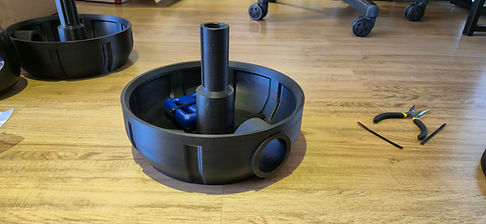
The filter in the photo to the left was modelled from a discontinued line of filters from an Australian manufacturer but was the preffered choice of anything on the market by our customer. So we recreated the filter using 3D printed parts and off the shelf parts. The material is UV and chemical resistant, lightweight and impact resistant making it a great choice for this application. The part has been in use for 18 months with great feedback from our customer.
We love to help our customers solve their problems and can come up with a solution for you too, so reach out to us for a no obligation chat to see if 3D printing is the right fit.